

You know that feeling when you get up from your chair after a full day at the office working on your laptop—and you can really feel how stiff all your muscles are? Or after a few hours on public transportation—no matter how you try to position yourself, your muscles still get stiff, and sometimes it’s even hard to stand up. And sometimes you wake up in the morning and realize that your head was resting awkwardly on the pillow all night, and now your neck is going to ache for a few days…
And usually the first thing you want to do in these situations is stretch and loosen up your muscles. This restores normal blood circulation, and your body gradually returns to normal. But sometimes a self-administered manual massage just isn’t enough: you simply lack the strength and pressure intensity to reach the deep muscles. Going for a professional massage is quite expensive, and you don’t always have the time. The alternative is a portable home massager, a device you can use on your own.
In this article, we’ll explain what a percussion massager is, what it’s used for, and how to use it correctly to reap the benefits rather than cause harm.

What is a percussion massager and how does it work
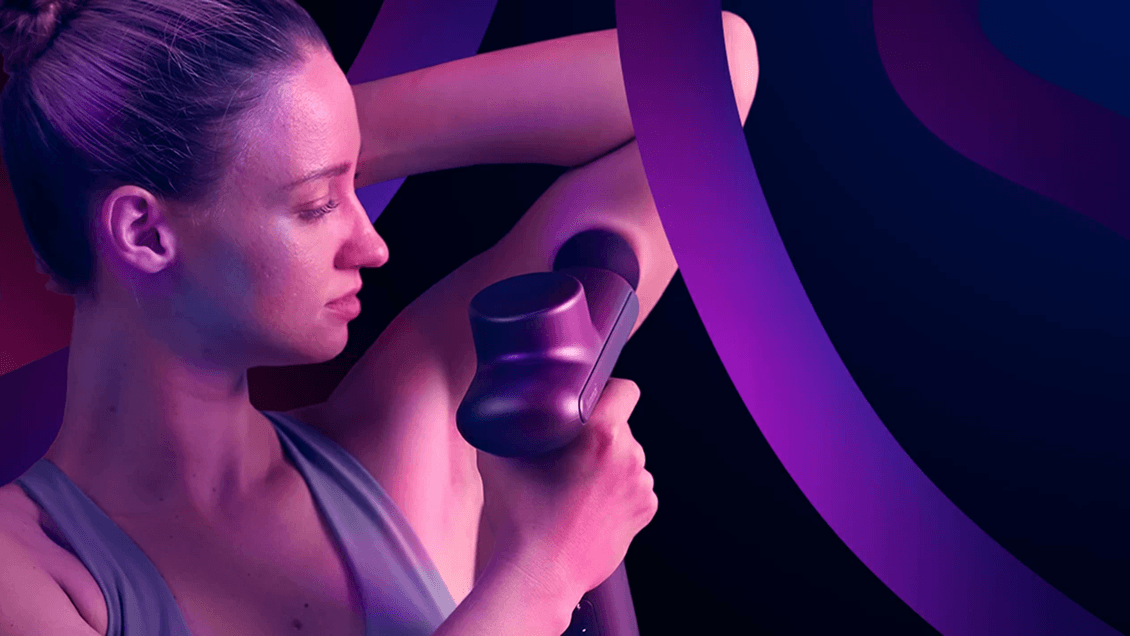
A percussion massager is a compact device that delivers frequent, rhythmic taps to the body’s surface. In shape, these massagers most often resemble a pistol, only slightly larger in size.
Its operation is based on the principle of percussive therapy. This is a method in which the muscle receives a series of short pulses under light pressure. Each pulse is a micro-stimulation that triggers a whole cascade of beneficial processes: blood flow improves, muscles “wake up,” and tension gradually dissipates. The body responds to the rhythmic micro-pulses by increasing local blood circulation and lymph flow—hence the warming and relaxing effect within just a minute of use.
To understand how it works, imagine this: you lightly tap a stiff leg (or any other “stiff” part of the body) with your fingers—and after a couple of seconds, it feels better. The percussion massager essentially does the same thing, only much faster, more powerfully, and more precisely:
- It delivers rapid, targeted taps that reach deep muscle layers.
- It improves blood circulation and accelerates local metabolic processes.
- It helps muscle fibers release tension after static exertion or a workout.
- It reduces stiffness and pain in trigger points (provided that percussion therapy can be used in these areas).
- It stimulates lymphatic drainage and reduces the feeling of heaviness in the body.
The sensation is similar to the active tapping of an experienced massage therapist’s fingers—not painful, but rather invigorating. After 40–60 seconds, the area is already warmer, softer, and more flexible. That’s why the percussion massager will be especially appreciated by those who sit a lot, work out, or simply experience muscle tension on a regular basis.
Essentially, the device works like a personal mini-massage therapist: it’s always at your fingertips, requires no special medical skills (though a basic understanding of anatomy is still helpful), and delivers noticeable results in just a couple of minutes. The key is to use it correctly, which is what we’ll discuss in the following sections.
Perkussion Massager Attachments and Their Purpose
Typically, a perkussion massager comes with several different attachments, and this isn’t just “variety for variety’s sake.” Each attachment provides a distinct type of stimulation: gentler, more targeted, deeper, or, conversely, more delicate. The right choice is half the battle, because it’s important for us to work on the muscles not only effectively but also safely.
So, let’s break down what the attachments are and what they’re for:
- Thermotherapy (flat, heated). Used to gently warm up the muscles before the main massage (or instead of it, if active massage is contraindicated). It helps relieve superficial tension, improves local blood flow, and makes the subsequent deep massage more comfortable. Especially suitable for the neck, lower back, and shoulders.
- Round. A versatile attachment of medium softness. Ideal for large muscle groups—thighs, buttocks, lower back, and shoulders. It gently distributes impact, making it suitable for those just starting to use the massager.
- Cone-shaped. Provides a more targeted, precise massage. It is used for localized treatment of trigger points, deep muscles, or areas with hard-to-reach tension.
- Multi-point. Provides a “diffused” massage thanks to multiple protrusions. Well-suited for relaxing tense areas where sensitivity needs to be reduced and the muscle gently stabilized without applying too much pressure to a single point.
- Spherical. Another versatile attachment, but rounder, more like a rubber ball. It is used for active recovery after workouts: quadriceps, calves, trapezius, and muscles along the spine. It balances between depth of impact and comfort.
- Straight. The most precise and firm. Suitable for deep penetration into small areas: localized knots, trigger points, and tendon attachments. It is used briefly and very sparingly.
- U-shaped. A specialized attachment for muscles located on either side of the spine. It allows you to work around the spinous processes themselves without injuring them and to gently work the paravertebral muscles. It is also convenient for the Achilles tendon.
- Flat. Provides a fairly superficial but even and broad effect. Used to relax sensitive areas where deep percussive massage may be uncomfortable: chest muscles, front of the thighs, arms.
These attachments allow you to tailor the massager to any task—from light relaxation after a workday to targeted work on problem areas. It’s important to try them out and choose the ones that feel comfortable for you. And while you’re unlikely to find a complete, universal set of all attachments in the package, there will definitely be a few different ones, so there’s plenty of room to experiment.

How to Use a Percussion Massager Correctly: A Step-by-Step Guide
Learning how to use a percussion massager is actually easier than it seems at first glance. It’s not a complicated technique, but rather a matter of getting used to it: figuring out which attachment to choose, what speed to start at, and exactly how to work with your muscles so that the massage is relaxing and pleasant, rather than painful and uncomfortable. Of course, at first you’ll need to get used to the sensations (since the massage gun itself vibrates quite strongly in your hand), listen to your body, and understand how it reacts—and then everything will come naturally.
Start by choosing an attachment and the area you want to work on. Muscles “respond” best to massage when the body is in a relaxed state: not immediately after or during a workout, and definitely not in the cold. Next, turn the device on at the lowest speed—let the muscles “get used” to the new sensation first. Simply hold the massager against the skin’s surface; there’s no need to apply extra pressure. To start, you can use a flat or spherical attachment.
After a few seconds, once your body starts to adjust, you can move on to the basic routine:
- If needed, select and switch attachments based on muscle sensitivity.
- Set the intensity to the lowest level—always start there.
- Move the massager slowly along the muscle, without sudden stops.
- Try to keep contact light; do not press the device into the body.
- Usually, 30–90 seconds per area is sufficient (but no more than 2 minutes), and then we smoothly move on.
The key is not to rush. The percussion massager doesn’t respond well to sudden jerks or forceful pressure. It works through vibrations, not pressure, so our job is simply to guide it. If you want to increase the intensity, do so gradually as well: one intensity level up—and then take a couple of seconds to check in with how it feels.
During the process, the muscle should become slightly softer, warmer, and more flexible—this is a normal reaction. If it feels “too much” in any area, simply reduce the speed or move to the next area. On average, each area takes very little time—just a couple of minutes—and then you can move on.
After the massage, give your body a few seconds to “come to.” A minute or two of rest, some light stretching, or simply moving your joints gently will enhance the effect.
When and how often can you use a massage gun
A massage gun is a versatile tool: you can use it to warm up your muscles before a workout, relieve tension afterward, or simply help your body recover after a workday. The key is to figure out which mode suits your needs and, of course, not to overdo it.
For example, you can use a massage device before a workout. The goal here is to wake up your muscles, improve flexibility, and prepare your body for exercise. Twenty to forty seconds per major muscle group you plan to use is sufficient. It’s best to use a low or medium speed, without applying too much pressure. This is more of a dynamic “warm-up” than a deep massage.
Sometimes muscles get tight right in the middle of a workout—for example, during strength training or a long run. In such cases, you can quickly run the massager over the tense area for 15–20 seconds to restore mobility. This helps relieve local tension and allows you to continue without feeling “stiff” in your body.
Here, it’s important to use it briefly, more like a technical break, and not immediately after finishing a set, but to give your muscles at least a minute to come out of the active state.
But perhaps the first thing that comes to mind when talking about using a massager in general is after a workout. After a workout, muscles often feel tighter, sometimes don’t respond well, and overall, the sensation is frankly not great. A massager helps speed up recovery, improve blood flow, and actually make the next day much more pleasant—with less soreness.
Aim for 1–2 minutes per area, work at a steady pace, and choose a comfortable speed. You can apply a little more pressure here, but don’t overdo it—you don’t want to cause an injury.
Can you use a percussion massager every day?
If you don’t work out regularly but do lead a sedentary lifestyle, a massager can still be beneficial. The muscles in your neck, shoulders, lower back, and legs (if you work standing up) often get just as tired as after a workout. And severe stiffness in the lower back and neck can lead to frequent headaches, poor concentration, and bad posture.
In this case, you can use a massage gun 1–2 times a day for a few minutes on the problem areas. The key is not to turn this into an hour-long session: short, regular sessions are far more effective (just like with exercise).

Top 5 effective massage techniques for different body areas
A percussion massager can be used on almost the entire body, but each area reacts differently. In some places, you need to relax the muscles; in others, work them more deeply; and in still others, work especially gently so as not to disturb sensitive structures. That’s why we’re sharing universal techniques that work for most people and help you feel the benefits quickly without unnecessary discomfort.
Neck and cervical region
The neck is an area that requires very gentle, careful treatment. Here, it’s best to start with the slowest speed and light, top-to-bottom movements. You can use a cone-shaped or rounded attachment. You should work along the sides, avoiding the front of the neck—there are many blood vessels there and almost no muscles (except for the clavicular muscle).
A good technique is to glide along the muscle, pause for a few seconds over the tight area, and then continue the movement.
Trapezius Muscle
The “trapezius” is a classic area of tension for anyone who sits a lot. It’s best to work this area at a moderate intensity with slightly firmer pressure. The movements can be short, as if you’re kneading the area, but without applying strong pressure.
To make it easier, you can use a simple routine:
- Start at the top, at the base of the neck.
- Slowly move toward the shoulder.
- Go over each section 2–3 times.
- If you wish, you can increase the speed by one level.
Of course, ideally, you should have someone help you, since the trapezius muscle extends below the shoulder girdle, narrowing between the shoulder blades, and you can’t reach that area on your own. But if that’s not possible, first and foremost, focus on how it feels, and if you feel any discomfort, stop immediately.
Back
There is a very important detail regarding the back: under no circumstances should you place the massager on the spine. We work only on the muscles on both sides. A gentle pace and long movements from top to bottom along the muscle ridges are suitable. If there are hard, tight spots, you can linger on them for just a few seconds without applying pressure. It’s best to choose a rounded, U-shaped, or multi-point attachment, and be careful not to catch the spinous processes (at the very least, this will cause extreme discomfort).
The technique here is more soothing: the muscles warm up gradually, and the tension dissipates evenly.
Legs
The quadriceps and calves respond well to more vigorous stimulation. You can use medium or high intensity if it feels comfortable. Move along the muscles in long, smooth strokes. This is just what you need to speed up recovery after a workout.
If your legs are tired after a day on the go, the “slow warm-up” technique is ideal: use the lowest speed and light pressure for 40–60 seconds on each area.
Glutes
This is one of the most “spacious” muscle areas: you can safely work deeper here. Both the spherical and flat attachments work great. It’s best to move the massager in an arc, gently moving from the outer part toward the center and back. If you feel a tight spot, you can slow down a bit, but don’t linger too long in one spot. It’s the perfect aid for quick recovery after a glute workout.
- Work at medium intensity.
- Move in wide arcs.
- Avoid the sacrum area.
- Massage each side for 1–2 minutes.
These techniques don’t require any special experience—just attention to your own sensations. If you do everything calmly and gradually, your muscles respond much better, your workouts become more effective, and recovery is faster and more comfortable.

Tests and Reviews of Popular Massage Gun Models
Our team took three Yunmai percussion massager models and put them through their paces: some had an intense workout yesterday and were practically sliding down the stairs, while others just spent the whole day at their laptops—in short, the conditions were as realistic as possible. We’ll compare them based on several different criteria: power/effectiveness, noise, battery life, and comfort.
Yunmai Massage Gun Mini 2
Very compact, the smallest in our entire lineup today, and it has a heating function. The massager itself weighs just over 300 grams, and the set includes 4 attachments and even a storage case. In short, it’s the top choice to toss into a gym bag or travel bag so you always have “first aid” with you.
But the most interesting feature of this model is the heating function. It comes with a special attachment with a flat surface, and the device heats up to 42.5°C in just 10 seconds. It’s a top-tier option for a gentle heat massage (for example, if you’ve caught a cold). It also features minimal noise and an 8 mm stroke length.
And, to cut to the chase, our team liked this one the most—its compactness, functionality, and convenience. The Yunmai Massage Gun Mini 2 runs for up to 10 hours on a single charge and charges via a standard USB-C port—in short, the perfect choice for travel, the gym, and home use.
Yunmai Massage Gun Prime 2
It’s slightly larger than the previous model, comes with a different set of attachments, and has a higher pressure rating—16 kg compared to 8 kg in the Yunmai Massage Gun Mini 2. Of course, this extra power comes at the expense of compactness: the massager is larger and heavier. Included in the set, in addition to the gun itself, are 4 attachments and even a docking station and a case to store all the accessories in one place.
The amplitude is also greater here—10 mm—and the massager can automatically adjust the pressure to avoid excessive force. A single charge lasts for about 60 days of use, assuming 10 minutes of daily use.
While the first model is designed more for everyday relaxation and travel, the Yunmai Massage Gun Prime 2 is designed for active recovery after workouts or intense physical exertion.
Yunmai Massage Gun PRO Percussion Massager
The first thing our team noticed was a feeling of power without aggression. The device operates with confidence but isn’t “harsh,” which is unexpectedly pleasant during deep massage. Even after a tough workout (when your quads feel like stone), the Yunmai Massage Gun PRO doesn’t “hit” but rather gently “works through” the muscle from the inside.
In terms of noise, the massager is a pleasant surprise—it’s quieter than you’d expect from such power (around 45 dB according to the manufacturer). This allows you to use it comfortably at home in the evening.
Battery life is another plus: the device easily lasts through long sessions, which is especially important if you plan to regularly work on large muscle groups. It’s rated for up to 800 minutes of use, and in real-world testing, no one on the team managed to drain the battery even after a week, despite the device being used several times a day by different people.

Common mistakes when using a percussion massager
Even the simplest device can be used incorrectly and produce negative results, and percussion massagers are no exception. Most mistakes aren’t related to the technique itself, but to the habit of applying “more pressure and for longer,” hoping for quick results. But here, the opposite is true: the more gentle the approach, the better the response from the muscles.
And to ensure the massage actually helps rather than causing unnecessary discomfort, it’s worth avoiding a few common mistakes:
- Applying too much pressure to the massager.
- Working on a single spot for too long (more than 10–15 seconds per session).
- Hitting bones and joints.
- Using the highest speed setting right from the start.
- Using it on inflamed areas (especially after injuries or strains—you’ll only make things worse).
- Using it on dry skin during prolonged sessions (a soft layer of clothing or a light fabric pad can make the process more comfortable).
A percussion massager isn’t about force, but rather about rhythmic and gentle stimulation that helps the body gradually return to normal. The key is to proceed carefully and listen to your body.
Contraindications: Who Should Not Use a Percussion Massager
A percussion massager is a safe household device, but there are situations in which its use can be harmful. First and foremost, this applies to any acute inflammatory conditions, recent injuries, severe pain of unknown origin, or conditions associated with impaired sensation. You should also not use the massager on areas with skin conditions, open wounds, severe swelling, or where surgery has recently been performed—the tissues in these areas require healing and are not ready for impact.
There are also conditions where a massage gun is not suitable from the outset. These include pregnancy (especially in the later stages), blood clotting disorders, thrombosis, severe cardiovascular diseases, implanted pacemakers, severe osteoporosis, and other musculoskeletal disorders.
In any such cases, it is best to consult a doctor first before making a decision.

Frequently Asked Questions About Percussion Massagers
What are the benefits of a percussion massager?
Percussion therapy helps relax tense muscles, improves blood circulation, and speeds up recovery after exercise.
How do I perform a percussion massage on my own?
Choose the appropriate attachment, set the massager to a low speed, and slowly move it along your muscles. Apply moderate pressure and don’t linger on any one spot for more than a few seconds.
How often can you use a massage gun?
Ideally, 3–6 times a week, depending on how you feel. A short warm-up before a workout is sufficient, and after exercise, you can spend a little more time relaxing.
What can you massage with a percussion massager?
Large muscle groups are suitable: the neck, shoulders, trapezius, back (avoiding the spine), thighs, glutes, and calves. You should not direct the massager toward bony prominences, joints, or sensitive areas.
Share:
Muscle recovery with Yunmai: how a percussion massager works